Before the appointment
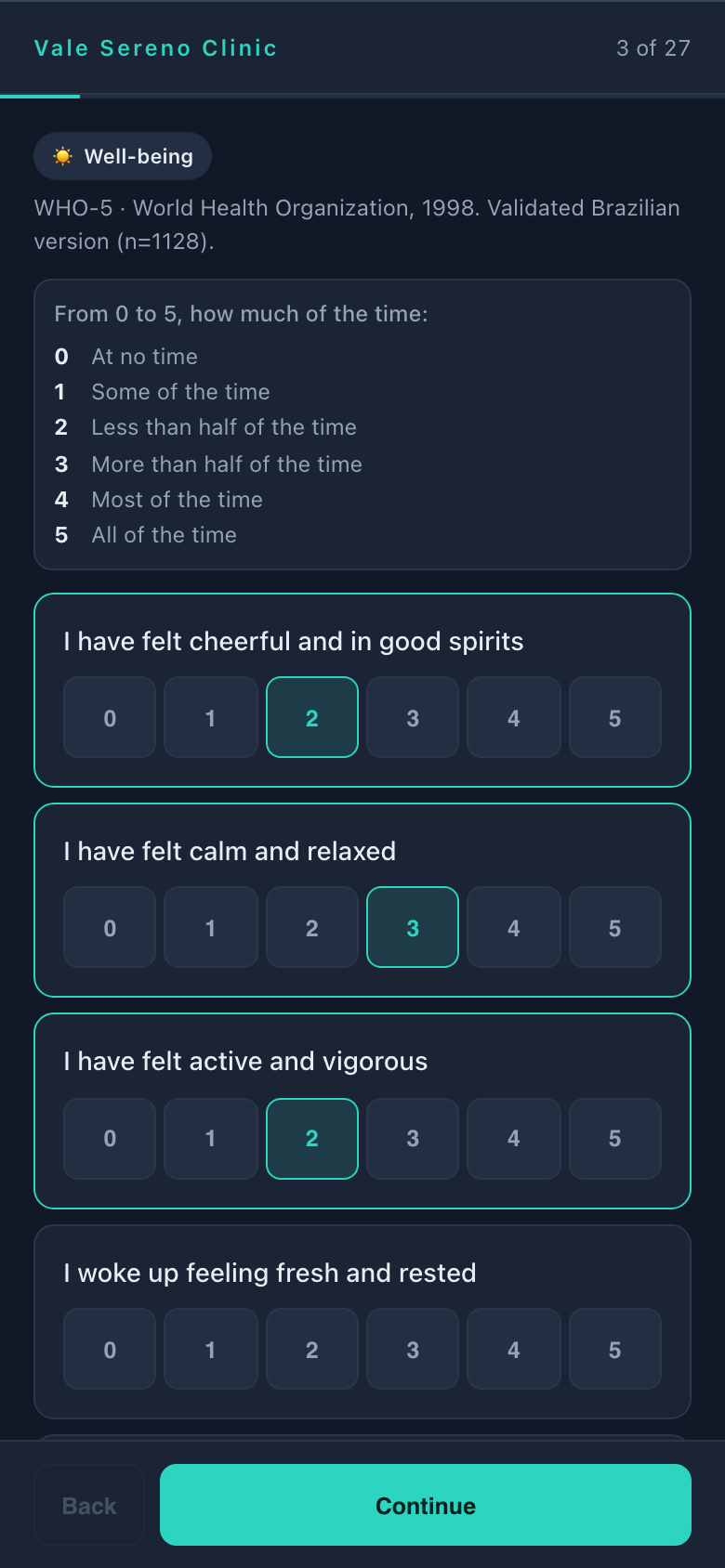
The patient answers on their phone, at their own pace. The questionnaire organizes sleep, energy and other complaints by body system. Answers from different assessments help prepare the conversation.
 SOLONEXA
FOR THOSE WHO CARE FOR PEOPLE
Scheduling, medical records, front desk and patient follow-up. One single story, from first contact to the next appointment.
Built in the daily routine of a clinic. Designed for yours.
System screens · fictitious examples
One record.
Far less scattered information.
SEE IT FROM THE INSIDE
The same patient in the schedule, in the conversation and in the follow-up. Choose an area and see the screens that are already part of the routine.
ATLAS · CLINIC MANAGEMENT
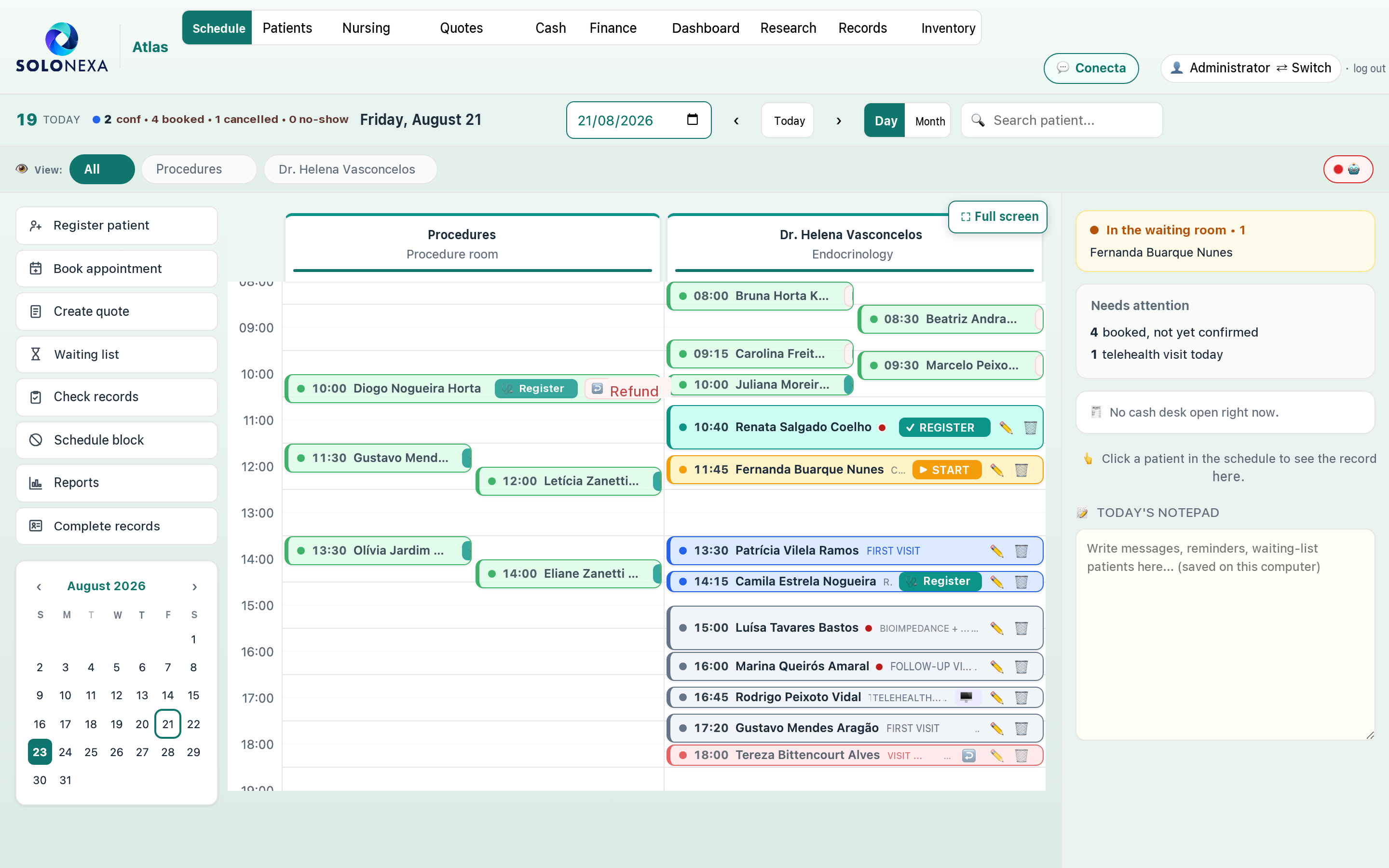
Who is arriving, what has been done and what comes next. Schedule, patient file and medical record help the team follow every step of care.
Also in Atlas: finance, inventory, lab tests and documents.
HEALTH EVOLUTION
On the patient's side, a simple way to take part. On yours, organized information to follow what has changed.
The patient records how they are doing. The answers help organize the conversation, alongside lab tests and the clinician's assessment.
Try answering on the phone beside this text. Demonstration: nothing is saved.
Discover the Patient Portal ↗PROFESSIONAL VIEW · FICTITIOUS EXAMPLE
Interpretation and clinical decisions belong to the health professional.IN THE APPOINTMENT · THE WHOLE STORY
Each symptom side by side on the dates it was asked about. Lab tests complete that story, so you can assess the whole picture and talk about progress.
The patient answers on their phone, at their own pace. The questionnaire organizes sleep, energy and other complaints by body system. Answers from different assessments help prepare the conversation.
Lab tests can be viewed as cards, on a scale or as a history in numbers. Filters help find each group and compare samples. Interpretation and any treatment decision stay with the clinician.
Real system screens, with fictitious data. They do not represent treatment results or a promise of improvement.
CONECTA · YOUR TEAM IN THE SAME CONTEXT
Conversations no longer live on one person's phone. Your team finds the queue, the history and who has already replied, right next to the patient's record.
Confirmations use the Atlas schedule. Messages are ready for the front desk to review and approve.
CARE FOR INFORMATION, TOO
Each clinic has its own database and credentials. Every organization looks after its own space.
Permissions for those who need to work, according to each team member's role.
The system organizes the records. Interpretation, guidance and clinical decisions belong to the professional.
WHO MAKES IT
This system did not start as a product. It started as the way a real clinic got through its own day, and it only became a product after surviving that whole day, many times over.
SOLONEXA is a single word, on purpose. The first four letters come from the beginning of the names of the two daughters of the person who created the system. The ending comes from nexus: a link, what brings together what was loose.
Together, it is what the brand sets out to be: the intelligent connection that centralizes and simplifies the work of health professionals.
Every screen here exists because something was missing on an afternoon of appointments. The schedule, the front desk queue, patient follow-up: none of them came from a feature list. They came from a problem that showed up with people waiting in the room.
That is why the system has fewer buttons than most. Whatever did not solve anything day to day was gradually removed.
The person who writes the system sees patients with it. There is none of the usual distance between those who make the software and those who put up with it: it is the same person, in the same week, on the same screen.
In practice this means a defect is found while seeing patients, not in a report, and that the system keeps changing, because the clinic that uses it keeps changing.
SHALL WE GET TO KNOW YOUR ROUTINE?
Tell us how you work. Let's talk about what makes sense for your team and your patients.